⭐ ⭐ ⭐ ⭐ ⭐ 4,92/5 🔵✓
Last Updated: August 31, 2026
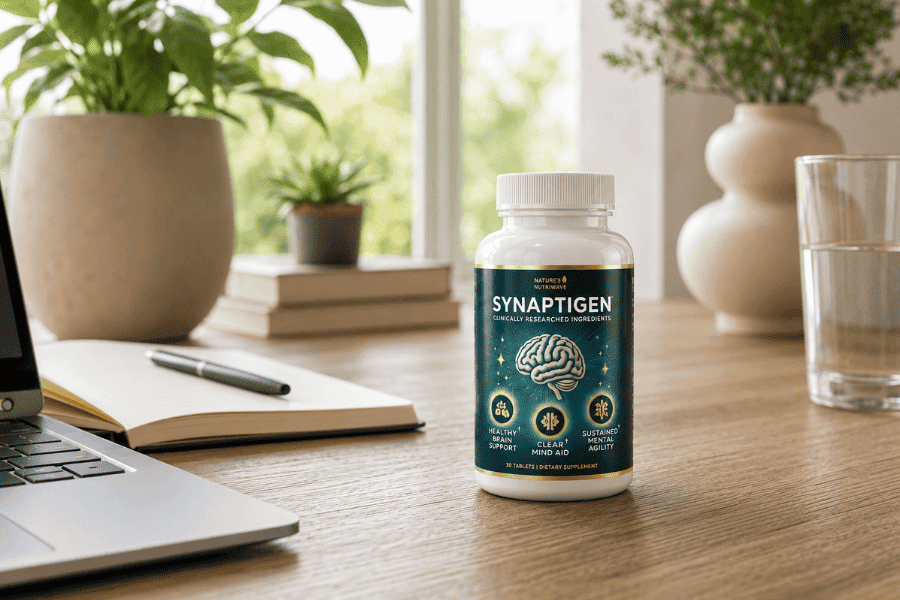
If you’re searching for Synaptigen reviews and complaints, you may be wondering whether this supplement is actually worth buying or whether its marketing claims go beyond what the available evidence can support.
Synaptigen is marketed as a dietary supplement for cognitive wellness, with websites promoting potential support for areas such as memory, focus, mental clarity, and long-term brain health. Some versions of the product are presented as containing ingredients such as Bacopa monnieri, Lion’s Mane, Ginkgo biloba, citicoline, omega-3 fatty acids, and other nutrients or botanical extracts.
However, our research uncovered an important issue before we could give Synaptigen a straightforward recommendation: different websites using the Synaptigen name currently describe different formulas.
That makes it difficult to evaluate the product as one clearly defined supplement.
In this review, we’ll look at what Synaptigen claims to do, the ingredients associated with different versions of the formula, what the available scientific evidence actually tells us, potential complaints and concerns, pricing and refund claims, and what consumers should verify before making a purchase.
Most importantly, we’ll separate evidence about individual ingredients from evidence about Synaptigen itself.
Our goal is not to tell you that Synaptigen works or doesn’t work. Our goal is to explain what we could verify and where the evidence remains uncertain.
Quick Verdict: Synaptigen Reviews and Complaints
Our verdict: Proceed With Caution
Based on the information we could independently verify, we cannot confidently recommend Synaptigen at this time.
This does not mean that Synaptigen is ineffective, unsafe, or fraudulent.
It means that the available independent, product-specific evidence is not strong enough for us to make a confident recommendation.
The biggest concerns we identified are:
- Different websites present different Synaptigen formulas.
- Independent product-specific evidence appears limited.
- Some marketing claims are considerably broader than the evidence available for the finished product.
- Research on individual ingredients should not be interpreted as proof that Synaptigen itself produces the same results.
- Some pages use FDA-related language that consumers should interpret carefully.
The FDA states that it does not approve dietary supplements for safety and effectiveness before they are marketed.
Our preliminary rating
| Category | Assessment |
|---|---|
| Ingredient concept | ⭐⭐⭐☆☆ |
| Formula transparency | ⭐⭐☆☆☆ |
| Independent evidence | ⭐⭐☆☆☆ |
| Product-specific evidence | ⭐⭐☆☆☆ |
| Marketing transparency | ⭐⭐☆☆☆ |
| Overall confidence | ⭐⭐½☆☆ |
Overall rating: 2.5/5 — Insufficient independent evidence for a confident recommendation
What Is Synaptigen?
Synaptigen is marketed as a dietary supplement intended to support cognitive wellness.
Depending on the website being reviewed, the product is promoted for areas such as:
- Memory
- Focus
- Mental clarity
- Cognitive wellness
- Mental energy
- Healthy aging
- Gut-brain support
One version of the Synaptigen website describes a formula containing ingredients such as citicoline, Bacopa monnieri, Lion’s Mane mushroom, omega-3 fatty acids, Ginkgo biloba, phosphatidylserine, and L-theanine.
However, another Synaptigen website describes a formula based around probiotics, prebiotics, strawberry extract, peppermint extract, and other ingredients.
A separate Synaptigen page lists an even broader combination that includes ingredients such as B vitamins, maritime pine bark, Lion’s Mane, phosphatidylserine, L-theanine, L-tyrosine, omega-3s, Ginkgo, Rhodiola, magnesium, and probiotics/prebiotics.
This is not a minor difference.
It makes it difficult to discuss “the Synaptigen formula” as though there were only one clearly established formulation.
Why the Formula Difference Matters
When evaluating a dietary supplement, the ingredient list is fundamental.
Suppose a study investigates Bacopa monnieri.
That study tells us something about Bacopa under the specific conditions of that study.
It does not automatically tell us that a supplement containing Bacopa will produce the same outcome.
The same principle applies to Lion’s Mane, Ginkgo, citicoline, omega-3s, or any other ingredient.
And if different websites are presenting different formulas, the consumer needs to determine which actual product and label they are purchasing before trying to evaluate its ingredients.
This is one of the main reasons we are taking a conservative position on Synaptigen.
What Does Synaptigen Claim to Do?
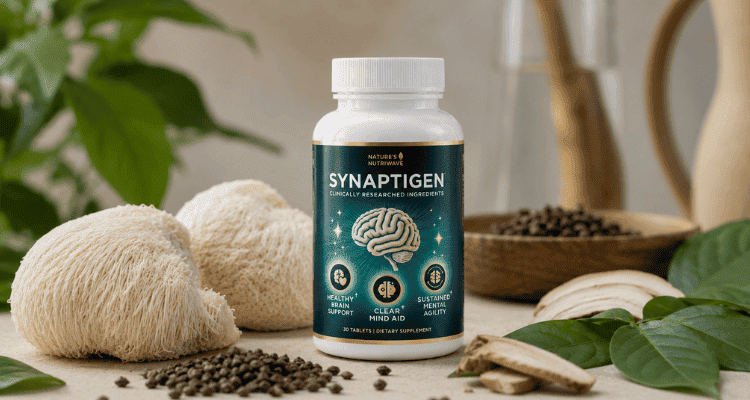
Synaptigen’s marketing materials generally position the product as a cognitive-support supplement.
Depending on the website, claims include support for:
Memory
The product is marketed as supporting memory and recall.
Focus
Some pages describe Synaptigen as supporting concentration and sustained attention.
Mental Clarity
Several marketing pages associate the supplement with clearer thinking and reduced “brain fog.”
Long-Term Cognitive Wellness
Some websites also promote Synaptigen as a product for long-term brain health and healthy cognitive aging.
These are marketing claims.
They should not automatically be interpreted as clinically established outcomes for the finished Synaptigen product.
That distinction is particularly important when evaluating supplements sold online.
Synaptigen Ingredients
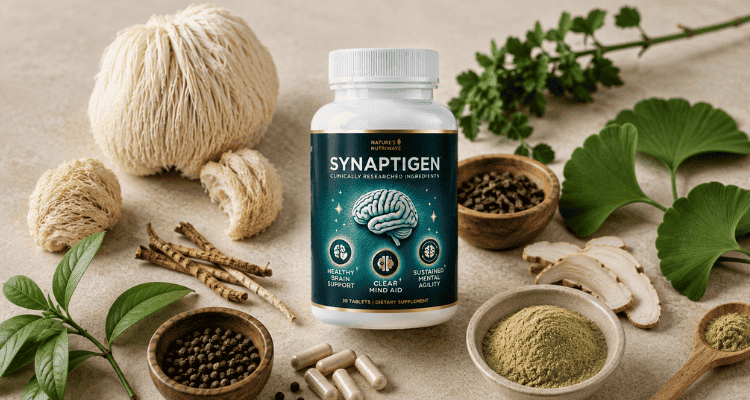
This is probably the most complicated part of our review.
There isn’t one consistently presented ingredient list across the websites we found.
Some pages list a formula centered around:
- Citicoline
- Bacopa monnieri
- Lion’s Mane mushroom
- Omega-3 fatty acids
- Ginkgo biloba
- Phosphatidylserine
- L-theanine
Other pages describe:
- Lactobacillus strains
- Bifidobacterium
- Inulin
- Strawberry extract
- Peppermint extract
- Tricalcium phosphate
Another version lists a considerably broader formula containing ingredients such as:
- Citicoline
- Bacopa monnieri
- B vitamins
- Maritime pine bark
- Lion’s Mane
- Phosphatidylserine
- L-theanine
- L-tyrosine
- Omega-3 fatty acids
- Ginkgo biloba
- Rhodiola rosea
- Magnesium
- Probiotics and prebiotics
Our concern
A consumer shouldn’t have to guess which ingredient list represents the product being purchased.
For that reason, we recommend treating the actual Supplement Facts label on the product being purchased as more important than a generic online description.
The FDA also explains that dietary supplement labels are expected to provide a Supplement Facts panel containing information such as serving size and the dietary ingredients in the product.
What Does the Science Say?
This is where we need to be particularly precise.
There is research on several ingredients associated with different versions of Synaptigen.
But:
Research on an ingredient is not the same as clinical evidence for Synaptigen.
Let’s look at a few examples.
Bacopa Monnieri
Bacopa monnieri has been studied for potential effects on memory and cognitive performance.
One randomized, double-blind, placebo-controlled trial investigated a standardized Bacopa extract in 98 healthy adults over 55 and assessed memory performance over 12 weeks.
Another randomized placebo-controlled study investigated a standardized Bacopa extract in medical students over six weeks.
More recent research has also investigated a standardized Bacopa extract in adults reporting memory and attention problems.
This makes Bacopa an interesting ingredient from a research perspective.
But it does not prove that Synaptigen works.
Why?
Because the studies involve particular Bacopa extracts, doses, populations, and study designs.
Unless Synaptigen’s exact product has been studied under comparable conditions, we cannot simply transfer those results to the finished supplement.
Lion’s Mane Mushroom
Lion’s Mane (Hericium erinaceus) is another ingredient frequently associated with cognitive supplements.
A small randomized, double-blind pilot study investigated Lion’s Mane supplementation in 41 healthy adults aged 18 to 45. The researchers examined acute and 28-day effects on cognitive function and mood.
Another randomized placebo-controlled study examined an acute dose of a standardized Lion’s Mane extract in 18 healthy younger adults.
These studies are interesting, but they are relatively small.
More importantly, they don’t establish that a commercially marketed product containing Lion’s Mane will necessarily produce the same results.
Therefore, we would describe Lion’s Mane as:
Promising enough to warrant research, but not sufficient evidence to prove Synaptigen’s effectiveness.
Ginkgo Biloba
Ginkgo biloba is one of the better-known ingredients used in supplements marketed for brain health.
However, the evidence is far from conclusive.
The National Center for Complementary and Integrative Health states that there is no conclusive evidence that ginkgo is helpful for any health condition and notes that large studies have not shown it to prevent or slow dementia.
NCCIH also notes that it remains uncertain whether Ginkgo supplements actually improve cognitive performance in healthy people.
That is an important reality check against overly broad marketing claims.
Citicoline
Some versions of Synaptigen list citicoline as an ingredient.
Citicoline has been investigated in relation to cognitive function, but again, the relevant question isn’t simply:
“Has citicoline been studied?”
The more important question is:
“Has the exact Synaptigen formula been shown in a well-designed clinical trial to produce the advertised outcomes?”
We did not find sufficient product-specific evidence to answer that question confidently.
Does Synaptigen Have Clinical Trials?
This is one of the biggest questions we asked during our research.
We found scientific studies involving individual ingredients associated with different Synaptigen formulas.
What we did not find was strong, independently verifiable evidence demonstrating that the finished Synaptigen product itself has been tested in a large, high-quality clinical trial showing that it improves memory, focus, or long-term cognitive health.
That distinction matters.
A company can accurately say that an ingredient has been studied while a consumer may mistakenly assume that the entire finished product has been clinically proven.
Those are two very different claims.
Synaptigen Reviews: What Are Customers Saying?
There are customer testimonials displayed on websites promoting Synaptigen.
Some testimonials describe experiences involving:
- Better focus
- Improved mental clarity
- Better memory
- Less brain fog
- Increased productivity
However, these testimonials are presented on promotional websites.
We therefore wouldn’t treat them as equivalent to independent clinical evidence.
A testimonial can tell us what one person says they experienced.
It cannot establish that:
- The person actually experienced the claimed effect;
- The supplement caused the effect;
- The same effect would occur in other consumers.
For a conservative review, those distinctions are important.
Synaptigen Complaints
The search term “Synaptigen reviews and complaints” suggests that consumers may be specifically looking for negative experiences.
Our approach here is simple:
We won’t manufacture a pattern of complaints where reliable evidence doesn’t establish one.
The independent complaint evidence we could verify is limited.
Instead, the concerns that stand out most clearly from our research relate to:
- Formula inconsistencies
- Marketing language
- Product-specific evidence
- FDA-related wording
- Limited independent evidence
That is more useful than simply compiling unverified complaints from random websites.
Concern #1: Different Websites, Different Formulas
This is our biggest concern.
One website describes Synaptigen as a formula containing ingredients such as Bacopa, Lion’s Mane, Ginkgo, and citicoline.
Another presents a probiotic/prebiotic formula.
Another presents an even broader formula containing numerous additional ingredients.
For consumers, this creates a basic question:
Which formula are you actually buying?
Until that question is answered, it is difficult to evaluate the product fairly.
Concern #2: “FDA Approved” Language
Some Synaptigen-related websites use phrases such as “FDA Approved Facility.”
This needs to be interpreted carefully.
The FDA explicitly states:
The FDA does not approve dietary supplements for safety and effectiveness.
A facility may be registered with the FDA or operate under applicable manufacturing requirements.
That is not the same thing as FDA approval of the finished supplement.
This distinction is important because consumers could otherwise interpret “FDA approved” as meaning that the FDA tested and approved Synaptigen for effectiveness.
That is not how dietary supplement regulation works in the United States.
Concern #3: Strong Marketing Claims
Some Synaptigen pages use language suggesting substantial improvements in:
- Memory
- Brain function
- Mental clarity
- Cognitive aging
- Brain-cell communication
- Neural health
Some claims may be framed around biological mechanisms or ingredient research.
But a biological mechanism is not automatically proof of a meaningful real-world benefit.
For example:
“This ingredient affects pathway X.”
doesn’t automatically mean:
“Taking this supplement will noticeably improve your memory.”
That is why our review takes a conservative approach.
Concern #4: Limited Independent Evidence
We found substantially more promotional material than independent product-specific evidence.
That’s not necessarily evidence that a product is bad.
But it does mean that consumers have less independent information with which to evaluate the product.
When evidence is limited, the appropriate conclusion isn’t automatically:
“The product doesn’t work.”
The more accurate conclusion is:
“We don’t currently have enough reliable evidence to recommend it confidently.”
Synaptigen Pros and Cons

Potential Pros
- Marketed as a stimulant-free cognitive supplement
- Some versions contain ingredients that have been studied individually
- Simple daily supplement format
- Several websites advertise a money-back guarantee
- The product targets a clearly defined consumer interest: cognitive wellness
Potential Cons
- Different websites list different formulas
- Limited independent product-specific evidence
- Marketing claims can be broader than the available evidence
- Some websites use potentially confusing FDA-related terminology
- Customer testimonials are not equivalent to clinical evidence
- Exact formulation and pricing should be verified before purchase
Is Synaptigen a Scam?
We would not label Synaptigen a scam based on the evidence we found.
That would be a stronger accusation than the available evidence supports.
At the same time, we would also not describe Synaptigen as clinically proven.
The most defensible conclusion is somewhere between those extremes.
Our position:
Synaptigen is a supplement marketed for cognitive wellness, but the evidence we could independently verify is insufficient for a confident recommendation.
The formula inconsistencies we found make it particularly important for consumers to verify the exact product they are purchasing.
Is Synaptigen FDA Approved?
No.
Synaptigen is marketed as a dietary supplement.
The FDA states that dietary supplements are not approved by the FDA for safety and effectiveness before they are marketed.
This does not mean a supplement is automatically unsafe.
It means the regulatory pathway for supplements is different from the pathway used for FDA-approved drugs.
Consumers should therefore avoid interpreting phrases such as “FDA-registered facility” or “FDA-approved facility” as proof that the finished supplement itself has been evaluated and approved by the FDA for effectiveness.
Is Synaptigen Safe?
We don’t think it’s appropriate to make a blanket statement that Synaptigen is “safe for everyone.”
Dietary supplements can interact with medications and may not be appropriate for every individual.
The FDA specifically recommends discussing dietary supplements with a doctor, pharmacist, or other healthcare professional before use.
This is particularly important for people who:
- Take prescription medication
- Take multiple supplements
- Have an existing medical condition
- Are pregnant or breastfeeding
- Are considering supplements for significant cognitive symptoms
If someone is experiencing persistent or worsening memory problems, relying solely on a supplement could delay appropriate evaluation.
What About the 180-Day Money-Back Guarantee?
Several Synaptigen websites advertise a 180-day money-back guarantee.
Some pages state that customers can request refunds within 180 days, while the exact terms can vary between websites.
This is another reason to save the terms and conditions associated with the specific purchase.
Before ordering, check:
- How long the refund period lasts
- Whether opened bottles are eligible
- Whether empty bottles can be returned
- Who pays return shipping
- Whether shipping fees are refundable
- How the refund must be requested
- Which company actually processes the order
Don’t rely solely on the phrase “180-day guarantee.”
Read the actual terms.
How Much Does Synaptigen Cost?
Current Synaptigen-related websites advertise different pricing structures.
One site currently lists $49 per bottle, while other pages show bundle pricing such as $69 per bottle or multi-bottle packages.
Because the pricing isn’t presented consistently across the different websites we found, we would not publish one price as though it were universally applicable.
Before purchasing, verify the final checkout amount.
Check:
- Number of bottles
- Cost per bottle
- Shipping
- Taxes, if applicable
- Refund terms
- Whether the order is one-time or recurring
How to Evaluate Synaptigen Before Buying
If you’re still considering the product, here’s the approach we’d recommend.
Step 1: Find the Actual Supplement Facts Label
Don’t rely exclusively on marketing descriptions.
Look for the actual label.
Step 2: Compare the Label With the Website
If the website says one thing and the bottle says another, stop and investigate.
Step 3: Check Ingredient Dosages
Knowing an ingredient is present isn’t enough.
The amount matters.
Step 4: Look for Product-Specific Research
Ask whether the finished product has been tested—not merely whether one of its ingredients has been studied.
Step 5: Read the Refund Policy
Save a copy before ordering.
Step 6: Check the Seller Carefully
Because we found multiple domains using the Synaptigen name, make sure you know which company is actually processing your order.
Step 7: Don’t Treat “FDA Approved” as a Quality Guarantee
The FDA does not approve dietary supplements for safety and effectiveness before marketing.
Synaptigen vs. Ingredient Research
Here’s the distinction that consumers should remember:
| Question | What We Found |
|---|---|
| Have some Synaptigen ingredients been studied? | Yes |
| Does that prove Synaptigen works? | No |
| Is there scientific interest in ingredients such as Bacopa and Lion’s Mane? | Yes |
| Does ingredient research prove the exact Synaptigen formula works? | No |
| Is the FDA approval claim straightforward? | No — it requires context |
| Is there enough independent evidence for a strong recommendation? | No |
This is why our rating remains conservative.
Who Might Be Interested in Synaptigen?
Synaptigen may appeal to adults looking for a dietary supplement marketed around:
- General cognitive wellness
- Focus
- Memory support
- Mental clarity
- Stimulant-free supplementation
However, interest in a product is different from evidence that it will provide a specific benefit.
Consumers should evaluate the actual formulation and their individual circumstances before deciding.
Who Should Be Especially Careful?
Extra caution is appropriate for anyone considering Synaptigen as a substitute for medical care.
The product should not be treated as a replacement for professional evaluation of:
- Significant memory loss
- Confusion
- Cognitive decline
- Neurological symptoms
- Suspected dementia
- Medication-related cognitive problems
The NCCIH notes that direct evidence that dietary supplements can prevent Alzheimer’s disease or other forms of dementia is lacking.
Our Synaptigen Reviews and Complaints Summary
After reviewing the available product information and independent scientific sources, here’s our overall assessment.
Product concept:
Interesting, but not enough to establish effectiveness.
Ingredients:
Several ingredients associated with Synaptigen have been researched individually, but the exact formula needs to be verified.
Scientific evidence:
There is evidence concerning some individual ingredients, but that shouldn’t be confused with evidence for the finished product.
Customer reviews:
There are promotional testimonials, but we found limited independent product-specific evidence.
Complaints:
We don’t have enough reliable evidence to establish a broad pattern of customer complaints.
Transparency:
This is the area that concerns us most because different websites present different formulas.
Overall confidence:
Low to moderate.

Final Verdict: Is Synaptigen Worth Buying?
Proceed With Caution
Based on the information we could independently verify, we cannot confidently recommend Synaptigen at this time.
That conclusion should not be interpreted as proof that Synaptigen is ineffective, unsafe, or fraudulent.
Instead, it reflects a simple problem:
There isn’t enough reliable, product-specific evidence for us to make a strong recommendation.
Some ingredients associated with Synaptigen have been studied in human research. Bacopa, for example, has been investigated in randomized trials, while Lion’s Mane has also been examined in small randomized studies.
However, research on an individual ingredient doesn’t prove that a particular finished supplement will deliver the same results.
Our concern is increased by the fact that different websites using the Synaptigen name currently describe different formulations.
We are also cautious about FDA-related marketing language because the FDA explicitly states that it does not approve dietary supplements for safety and effectiveness before they are marketed.
Our recommendation
If you’re considering Synaptigen, verify:
- The exact Supplement Facts label
- Ingredient dosages
- The seller
- The final price
- The refund policy
- Any recurring-payment terms
- The evidence supporting the claims being made
And if you’re considering the product because you’re experiencing significant or persistent memory problems, speak with a qualified healthcare professional rather than relying on a supplement alone.
RovixFitness Final Rating
2.5/5 — Insufficient Independent Evidence for a Confident Recommendation
Frequently Asked Questions
What is Synaptigen?
Synaptigen is marketed as a dietary supplement intended to support cognitive wellness, including areas such as memory, focus, and mental clarity.
Does Synaptigen really work?
We don’t currently have enough independent, product-specific evidence to confidently say that Synaptigen produces the benefits advertised by its marketers.
Some individual ingredients associated with different versions of the product have been studied, but that is not the same as clinical evidence for Synaptigen itself.
Is Synaptigen a scam?
We don’t have sufficient evidence to call Synaptigen a scam.
However, we found enough inconsistencies in online product information to recommend careful verification before purchasing.
Is Synaptigen FDA approved?
No. The FDA states that dietary supplements are not approved for safety and effectiveness before they are marketed.
What ingredients are in Synaptigen?
This is difficult to answer definitively because different websites using the Synaptigen name list different formulas. Some list ingredients such as Bacopa, Lion’s Mane, Ginkgo, and citicoline, while others list probiotics, prebiotics, and plant extracts.
Always check the actual Supplement Facts label.
Does Synaptigen contain Lion’s Mane?
Some versions of the Synaptigen formula listed online include Lion’s Mane.
However, verify the label of the specific product you are considering.
Does Synaptigen contain Ginkgo biloba?
Some online versions of the formula list Ginkgo biloba.
NCCIH says there is no conclusive evidence that Ginkgo prevents or slows dementia, and its effect on cognitive performance in healthy people remains uncertain.
Does Synaptigen have a money-back guarantee?
Several Synaptigen websites advertise a 180-day money-back guarantee.
However, consumers should verify the exact terms associated with their specific purchase.
How much does Synaptigen cost?
Prices vary between Synaptigen-related websites. Some currently advertise prices around $49 per bottle, while other offers show different bundle structures.
Check the final checkout price before purchasing.
Is Synaptigen safe?
We cannot make a blanket safety claim for every person. Dietary supplements can interact with medications, and the FDA recommends discussing supplement use with a healthcare professional.
Independent Sources & Further Reading
Para deixar o artigo mais forte e confiável, eu manteria estes links externos:
- FDA — Information for Consumers on Using Dietary Supplements
- FDA — Is It Really “FDA Approved”?
- FDA — Questions and Answers on Dietary Supplements
- NCCIH — Ginkgo: Usefulness and Safety
- NCCIH — Dietary Supplements and Cognitive Function
- PubMed — Bacopa monnieri randomized trial
- PubMed — Lion’s Mane randomized pilot study
Esses links são melhores para o artigo do que simplesmente colocar vários links de sites afiliados ou blogs de suplementos.
🔗 Related Synaptigen Articles
Synaptigen Reviews
Read our complete review of Synaptigen, including its formula, ingredients, claims, available evidence, pricing, and our overall assessment.
👉 Read the Full Synaptigen Reviews
Synaptigen Reviews Side Effects
Learn about potential side effects and safety considerations associated with Synaptigen, including important precautions to consider before using the supplement.
👉 Read Synaptigen Reviews Side Effects
Synaptigen Reviews Consumer Reports
Explore what we could verify about consumer feedback, independent reviews, and claims surrounding Synaptigen, while distinguishing promotional testimonials from more reliable sources.
👉 Read Synaptigen Reviews Consumer Reports